
Flame synthesis of nanomaterials
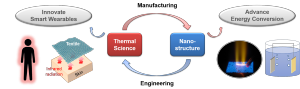
Functional materials are the key enabling factor for many scientific and technological advancements. Emerging energy conversion and wearable devices require highly efficient components to facilitate complex physical and chemical processes at small dimensions. Existing materials, however, often cannot satisfy the stringent requirements of emerging technologies. New materials and manufacturing processes need to be explored for attaining advanced functionalities. Our interest is focused on developing flame synthesis methods for the production of novel 0D, 1D and 2D nanomaterials in a low-cost and scalable manner. State-of-art characterization tools are employed to advance the fundamental understanding of unprecedented material properties at the limit of nanometer scale. The goal of this research is to enable impactful applications of novel nanomaterials in broader areas by removing the practical barriers in their large-scale manufacturing.
(Photo-)Electrochemical energy conversion
As population and living standards increase, the high energy demand and climate change have been the most pressing issues to our society that calls for more efficient and carbon-neutral energy technologies to be developed. We are particularly interested in fundamental research on energy conversion processes using photo- and electro-chemistry for the sustainable production of electricity, fuels, and chemicals. This research involves optimizing material composition and structure, probing chemistry and physics at interfaces, and studying catalysis on surface. The goal of this research is to deliver innovative systems with improved energy efficiency and reduced environmental impact.
Smart wearables
The intense interests in revolutionary wearable technology have stimulated the vision of smart textiles that can regulate temperature, monitor health and sense the environment. Realizing these intelligent functions in textiles will have important applications in personalized healthcare, safety, sports, military and space exploration. We are interested in fundamental engineering research on smart wearable technologies from material design, device fabrication to performance characterization. The goal of this research is to seamlessly incorporate electronic devices at the fiber level, allowing the flexible, breathable and washable attributes of textiles to be maintained.